By Dr Raman Narang | Consultant Medical & Hemato-Oncologist
Oligometastatic disease describes a state of cancer in which the disease has spread beyond its original location but remains limited to a relatively small number of metastatic sites. Unlike widely disseminated cancer, this state may offer an opportunity to treat all visible areas of disease, sometimes with the intention of achieving prolonged remission or even cure. However, not every patient with oligometastatic cancer is curable, and treatment decisions depend on the cancer’s biology, extent, response to therapy and available treatment options.
Oligometastatic Disease: Can Limited Cancer Spread Change Treatment Intent?
Introduction: Does Stage IV Cancer Always Mean Incurable Cancer?
For many years, cancer treatment followed a relatively straightforward distinction.
Early-stage cancers were generally approached with curative intent, using surgery, radiation or combinations of treatments. Once cancer had spread to distant organs, treatment was usually directed towards controlling disease, relieving symptoms and prolonging survival.
This distinction remains appropriate for many cancers. However, advances in imaging, systemic therapies, radiation techniques and our understanding of cancer biology have revealed an important limitation in this approach.
Not all metastatic cancers behave identically.
Some patients develop widespread disease involving multiple organs. Others have only one or a few distant metastatic deposits, sometimes remaining stable for a considerable period.
This observation helped establish the concept of oligometastatic disease.
The purpose of recognising this category is not to redefine every advanced cancer as curable. It is to identify patients in whom treating all known disease sites might meaningfully change the course of their illness.
1. What Exactly Is Oligometastatic Disease?
The word oligo means few.
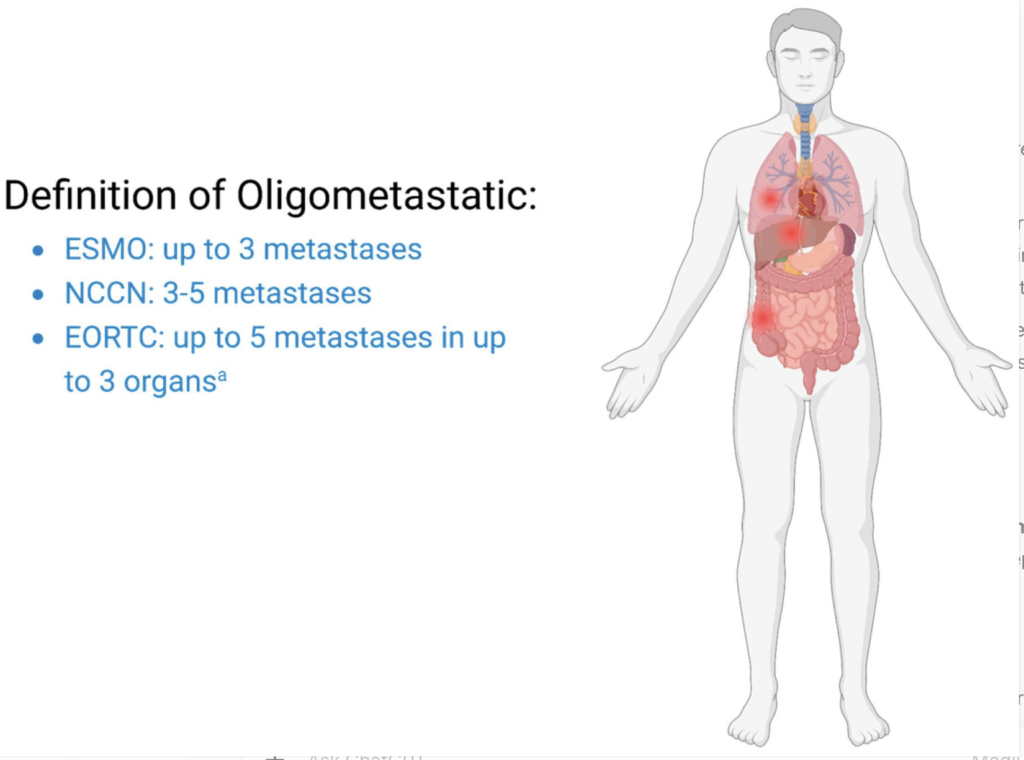
Oligometastatic disease refers to cancer that has spread from its primary site to a limited number of distant locations.
For example, a patient with lung cancer might have a primary lung tumour and two metastatic deposits in distant organs. Another patient previously treated for colorectal cancer might develop two isolated liver metastases.
Both situations could represent oligometastatic disease, depending on the complete staging assessment and clinical context.
Many studies have used thresholds of one to five metastatic lesions. However, there is no single numerical definition that applies universally to every cancer type.
The location of metastases, whether all lesions can be treated safely, previous treatments and the biological behaviour of the disease are just as important.
Importantly, oligometastatic disease is not a separate cancer stage replacing stage IV. It is a clinical description of a potentially distinct pattern of metastatic spread.
Are there different forms of oligometastatic cancer?
Yes. Recognising how and when the metastases developed can influence treatment decisions.
- Synchronous oligometastatic disease: A limited number of metastases are present when the cancer is initially diagnosed.
- Metachronous oligometastatic disease: Limited metastases appear after an interval following the original diagnosis or treatment.
- Oligorecurrence: Cancer returns at only a few locations after previous treatment, typically during a treatment-free interval.
- Oligoprogression: Most disease remains controlled on systemic treatment, but a few areas begin to grow.
- Induced oligometastatic disease: Previously widespread metastatic cancer becomes limited after systemic treatment.
These patterns are not interchangeable. For example, treating two newly diagnosed metastases may have a different objective from treating two resistant lesions while the remaining disease is controlled by targeted therapy.
2. Why Was Oligometastatic Disease Recognised as a Separate Category?
The concept challenges a long-standing assumption that all distant metastatic disease necessarily reflects the same degree of biological dissemination.
Cancer spread is not always an immediate transition from localised disease to uncontrolled involvement of multiple organs.
In some patients, metastatic spread may remain relatively limited for a period. This creates a possible window in which all detectable disease can be treated.
The original oligometastatic hypothesis proposed that some cancers occupy an intermediate state between localised and extensively metastatic disease.
This matters because the intention of treatment may change.
For widely metastatic disease, systemic treatment usually forms the mainstay of management, with local treatment used for selected symptoms or complications.
For appropriately selected oligometastatic disease, clinicians may consider combining systemic treatment with surgery or high-precision radiation directed at every known disease site.
The goal is to determine whether eliminating all visible disease can improve long-term outcomes, rather than automatically treating every stage IV cancer with the same strategy.
This concept also creates a framework for research. Instead of grouping all metastatic patients together, clinical trials can investigate which patterns of limited spread respond best to comprehensive treatment.
It is important to recognise that this is a treatment-oriented classification supported by evolving evidence, not proof that every oligometastatic cancer has inherently favourable biology.
3. Can Oligometastatic Cancer Actually Be Cured?
In selected patients, long-term disease-free survival and the possibility of cure are realistic treatment considerations.
One established example is colorectal cancer with limited, resectable liver metastases. Some patients can undergo complete surgical removal of the metastatic disease, with or without systemic therapy, and remain disease-free for many years.
Studies in other cancers have explored whether treating every metastatic site can produce similar benefits.
The SABR-COMET randomised phase II trial examined stereotactic ablative radiotherapy in patients with controlled primary cancers and one to five metastatic lesions.
Long-term follow-up demonstrated improved survival in the group receiving comprehensive stereotactic treatment. At five years, overall survival was approximately 42% in the stereotactic radiotherapy group compared with 18% in the control group.
However, this was a relatively small phase II study involving different cancer types. The results should not be interpreted as a general cure rate for oligometastatic cancer.
Not every clinical trial has shown the same benefit.
The NRG-LU002 study in metastatic non-small-cell lung cancer did not demonstrate improved progression-free or overall survival from routinely adding local consolidative treatment to maintenance systemic therapy in its studied population. Treatment-related toxicity was also higher.
The contrasting findings illustrate an important principle: the number of metastases alone does not determine whether aggressive local treatment will help.
Cure, durable remission and disease control are different outcomes. Even when all visible lesions disappear, microscopic cancer cells may remain undetected.
Therefore, the possibility of cure should be discussed individually, with an explanation of the available evidence and uncertainty.
4. How Can Precision Oncology Change the Treatment Strategy?
Precision oncology aims to select treatments based on the biological and molecular characteristics of an individual cancer, rather than relying exclusively on the organ where the cancer originated.
Its role in oligometastatic disease is particularly interesting because it can help address two separate questions:
How can we control cancer throughout the body, and can we safely eliminate the limited sites that remain?
Molecular profiling and targeted therapy
Certain cancers contain molecular alterations that predict sensitivity to specific targeted treatments.
In non-small-cell lung cancer, for example, testing may identify alterations involving EGFR, ALK, ROS1, RET or other actionable pathways.
An appropriate targeted therapy can sometimes produce substantial and sustained disease control.
Imagine a patient with metastatic lung cancer whose disease responds well to targeted treatment, but one or two isolated lesions remain active or begin progressing.
In selected circumstances, stereotactic radiotherapy or another local treatment may be considered for those lesions while an effective systemic treatment strategy is maintained.
This approach may delay the need to change systemic therapy. It does not automatically make the disease curable.
Immunotherapy and systemic disease control
Immunotherapy has changed the treatment landscape for several metastatic cancers.
Some patients experience durable responses, particularly when their tumour characteristics and clinical circumstances favour benefit.
When systemic treatment controls most disease sites, clinicians may reconsider whether persistent or isolated progressive lesions require additional local treatment.
However, the benefit of combining immunotherapy and metastasis-directed treatment is cancer-specific and remains an active area of research.
The potential role of circulating tumour DNA
Circulating tumour DNA, or ctDNA, is another developing area.
Blood-based molecular testing may help identify tumour-related genetic material and, in certain settings, provide information about residual disease or emerging treatment resistance.
In the future, ctDNA and other biomarkers may help distinguish patients with genuinely limited disease from those with microscopic dissemination that is not yet visible on scans.
For now, ctDNA-guided decisions about curative-intent treatment in oligometastatic cancer are not universally validated.
Precision oncology does not turn every metastatic cancer into a curable disease. Its contribution is to make treatment selection more biologically informed, and potentially more effective when combined with appropriate local therapies.
5. How Is Oligometastatic Disease Treated?
Treatment generally involves considering both systemic cancer control and treatment of individual disease sites.
Systemic therapy
Chemotherapy, targeted therapy, immunotherapy or hormone-based treatment may be appropriate depending on the cancer type, biomarkers, previous treatment and overall condition of the patient.
Systemic therapy is important because visible metastatic deposits may not represent the entire burden of cancer.
In some cancers, the response to initial systemic treatment also helps determine whether aggressive local treatment is worthwhile.
Surgery
Surgery may be considered when all relevant disease can be removed safely and the expected benefit justifies the risks.
Resection of selected colorectal liver metastases is an established example.
Surgical decisions depend on lesion location, remaining organ function, technical feasibility and the biological behaviour of the cancer.
Stereotactic body radiotherapy
Stereotactic body radiotherapy, commonly called SBRT or SABR, delivers highly focused radiation to defined tumour targets.
It can provide durable local control for selected metastatic lesions without requiring conventional surgery.
Its suitability depends on tumour size, location, surrounding organs, previous radiation and the number of sites requiring treatment.
Other local techniques, such as thermal ablation, may have a role in selected cancers and organs.
The central principle is not simply to deliver more treatment. It is to determine whether comprehensive disease-directed treatment offers sufficient benefit to justify its risks.
6. How Do Oncologists Decide Who May Benefit From Curative-Intent Treatment?
This is where clinical judgement and multidisciplinary review become essential.
What I look for clinically
When evaluating a patient with limited metastatic disease, I consider six important questions.
First, are we confident about the true extent of the disease?
Appropriate imaging—sometimes including PET-CT, organ-specific MRI or biopsy—is essential. Different cancers require different staging investigations.
Second, what is the cancer’s biological behaviour?
A cancer that develops two metastases after several disease-free years may behave differently from a rapidly progressing cancer that already shows multiple new lesions within weeks.
Third, is there an effective systemic treatment?
A meaningful response to systemic therapy may indicate a more favourable opportunity to consider local treatment, depending on the disease.
Fourth, can every clinically relevant site be treated safely?
There is little justification for a curative-intent local strategy if significant uncontrolled disease remains elsewhere.
Fifth, what are the risks and consequences of treatment?
Combining surgery, radiotherapy and systemic therapy may increase toxicity, treatment burden and cost. These risks must be weighed against the anticipated benefit.
Finally, what is the realistic treatment objective?
For one patient, the goal may be a possibility of long-term disease-free survival. For another, it may be delaying progression or prolonging the effectiveness of an existing systemic treatment.
The distinction should be clear before treatment begins.
A practical treatment decision map
If staging confirms a small number of metastases, all disease is potentially treatable, cancer biology is favourable and the patient is medically suitable, then a multidisciplinary team may consider a comprehensive treatment strategy with prolonged disease control or possible cure as an objective.
If most disease is responding but a few lesions are progressing, then local treatment may be considered to control resistant sites and potentially preserve an effective systemic regimen.
If disease is rapidly progressing, more widespread than initially thought or unsafe to treat comprehensively, then systemic treatment and symptom-focused care will generally take priority.
Seven questions patients should ask
- How many metastatic lesions are present, and where are they located?
- Has the full extent of disease been assessed with appropriate imaging?
- Is my cancer type known to benefit from aggressive treatment of limited metastases?
- Have the relevant molecular and biomarker tests been completed?
- Can all known sites be treated safely?
- Are we aiming for cure, prolonged remission or disease control—and what evidence supports that goal?
- What would be the risks, alternatives, follow-up plan and next steps if cancer returns?
Frequently Asked Questions
1. Is oligometastatic cancer still stage IV cancer?
Usually, yes. Oligometastatic disease describes the limited extent or pattern of distant spread. It does not automatically change the underlying stage classification.
2. Does having fewer than five metastases mean my cancer is curable?
No. The number of metastases is only one consideration. Cancer type, location, biology, systemic disease control and feasibility of treating all sites are equally important.
3. Can SBRT cure oligometastatic cancer?
SBRT can provide excellent local control in appropriately selected lesions and may contribute to long-term remission in some patients. However, local control of treated lesions is not the same as cure of the cancer throughout the body.
4. Can targeted therapy make stage IV cancer curable?
Targeted therapies can produce prolonged disease control in certain molecularly defined cancers. However, metastatic disease can develop resistance, and targeted treatment alone is not generally considered curative for most metastatic solid tumours.
5. Is oligometastatic disease the same as oligoprogressive disease?
Not exactly. Oligometastatic disease is an umbrella term for limited metastatic spread. Oligoprogression is a particular situation in which only a few disease sites progress while the remaining disease stays controlled, often during systemic therapy.
Closing Perspective: A Change in How We Think About Metastatic Cancer
The importance of oligometastatic disease extends beyond a new medical term.
It reflects a shift from treating all metastatic cancers as biologically identical towards recognising meaningful differences between patients.
For some, systemic therapy remains the most appropriate treatment. For others, combining effective systemic treatment with carefully selected local interventions may offer a chance of substantially longer disease control and, occasionally, cure.
Precision oncology strengthens this approach by helping clinicians understand the molecular drivers of cancer and select treatments more appropriately.
The question is no longer simply whether cancer has spread.
It is whether the extent, biology and behaviour of that cancer create an opportunity to change the intention of treatment.
When a patient has been diagnosed with a small number of metastatic lesions, a structured review of staging, pathology, molecular findings and treatment sequencing can be valuable before deciding whether treatment should focus on systemic control alone or include comprehensive local therapy.
Such decisions deserve an individualised discussion rather than assumptions based solely on the words stage IV.
Medical disclaimer: This article is for educational purposes and does not replace individualised medical advice. Eligibility for metastasis-directed treatment depends on cancer-specific evidence, detailed staging, clinical assessment and multidisciplinary review. Treatment outcomes, including the possibility of cure, cannot be predicted from the number of metastases alone.