Direct Answer: A liquid biopsy is a blood-based cancer test that looks for tumor-derived material, especially circulating tumor DNA or ctDNA, released by cancer cells into the bloodstream. It can help identify actionable mutations, monitor treatment response, and detect resistance when tissue biopsy is difficult or insufficient. It is not a universal replacement for tissue biopsy, but it is becoming an important part of precision oncology decision-making. :contentReference[oaicite:1]{index=1}
Authority Perspective: As cancer treatment becomes increasingly biomarker-driven, liquid biopsy is best understood not as a “simple cancer blood test,” but as a molecular tool that must be interpreted in the correct clinical context.
What Exactly Is a Liquid Biopsy?
A liquid biopsy is a test performed on blood or another body fluid to detect material released from cancer cells. The most commonly discussed component is circulating tumor DNA, often called ctDNA.
Cancer cells can shed small DNA fragments into the bloodstream. Advanced molecular platforms can analyze these fragments to identify cancer-related genetic alterations, including mutations, amplifications, fusions, and resistance markers.
Liquid biopsy may analyze different tumor-derived components such as ctDNA, circulating tumor cells, extracellular vesicles, RNA, or proteins, but ctDNA remains one of the most clinically developed areas in oncology.
In practical oncology, liquid biopsy is mainly used to answer molecular questions:
- Does the cancer have an actionable mutation?
- Is there a resistance mutation after targeted therapy?
- Is tissue insufficient for molecular testing?
- Can treatment response be monitored over time?
- Is there molecular evidence of recurrence in selected settings?
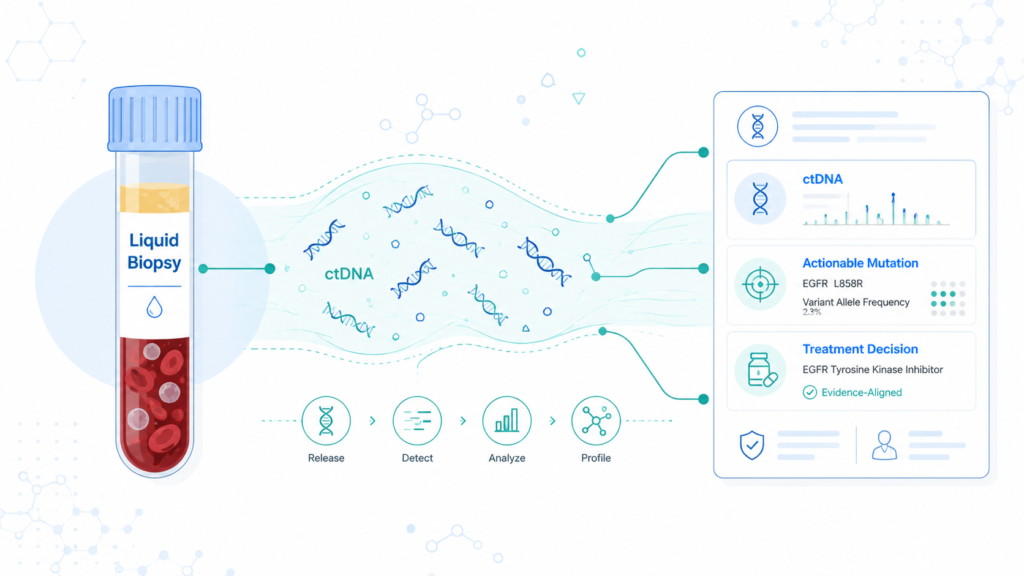
Liquid biopsy uses tumor-derived DNA in blood to support molecular profiling, treatment selection, and resistance assessment in selected cancers.
How Does Liquid Biopsy Work in Cancer?
Liquid biopsy begins with a blood sample. The sample is processed to separate plasma, where cell-free DNA fragments may be found. A portion of this DNA may come from cancer cells and is called ctDNA.
The laboratory then uses molecular methods such as next-generation sequencing or targeted mutation testing to look for clinically meaningful genomic changes.
For example, in lung cancer, liquid biopsy may help detect driver mutations when tissue is inadequate or when a repeat biopsy is difficult. This may influence selection of targeted therapies, especially when the result identifies a validated actionable alteration.
However, a negative liquid biopsy does not always mean that the cancer has no mutation. Some tumors shed very little DNA into the blood, particularly when disease burden is low or the cancer is confined to certain sites.
This is why interpretation matters: liquid biopsy is powerful when positive, but a negative result may still need tissue testing if clinical suspicion remains high.
Liquid Biopsy vs Tissue Biopsy: Which Is Better?
The more accurate question is not “which is better,” but “which test answers the clinical question more reliably at this point in treatment?”
A tissue biopsy remains essential for confirming cancer diagnosis, identifying histology, assessing tumor architecture, and performing many pathology-based tests. Liquid biopsy does not replace the need to know what type of cancer is present.
Liquid biopsy becomes especially useful when tissue is limited, unsafe to obtain, delayed, or when the oncologist needs a repeat molecular snapshot during treatment.
| Clinical Question | Tissue Biopsy | Liquid Biopsy |
|---|---|---|
| Confirm cancer diagnosis | Usually required | Not sufficient alone in most cases |
| Identify cancer subtype | Strong | Limited |
| Find actionable mutations | Strong if tissue is adequate | Useful, especially when tissue is limited |
| Repeat testing during treatment | May be difficult | More practical and repeatable |
| Detect resistance mutations | Useful | Often clinically helpful |
| Early cancer screening | Not a screening test | Still investigational for broad use |
In modern oncology, the best approach is often complementary: tissue biopsy for diagnosis and baseline characterization, liquid biopsy for molecular decision-making when appropriate.
Where Is Liquid Biopsy Most Useful Today?
Liquid biopsy is most useful when it changes a real treatment decision. Its strongest current role is in advanced cancers where molecular profiling can identify targeted treatment options or resistance mechanisms.
Examples include selected situations in lung cancer, colorectal cancer, breast cancer, prostate cancer, and other solid tumors where genomic information may influence therapy selection.
In lung cancer, liquid biopsy is particularly relevant because treatment may depend on actionable alterations such as EGFR, ALK, ROS1, BRAF, MET, RET, NTRK, HER2, KRAS G12C, and others, depending on histology and guideline context.
Liquid biopsy can also be useful after disease progression on targeted therapy, where identifying a resistance alteration may help guide the next line of treatment.
Can Liquid Biopsy Detect Early Stage Cancer?
This is one of the most common questions patients ask. The answer is cautious: liquid biopsy is promising for early detection, but it is not yet a universal screening test for the general population.
Early-stage tumors may release very small amounts of ctDNA. This creates a risk of false-negative results, where a cancer may be present but not detected in blood.
There is also a risk of false positives or uncertain findings, where a blood signal may require further testing but does not clearly identify a cancer source.
For now, standard cancer screening methods such as mammography, colonoscopy, Pap smear, HPV testing, low-dose CT in eligible high-risk smokers, and other evidence-based approaches should not be replaced by liquid biopsy.
Liquid biopsy for early cancer detection is an active research area, but clinical use must be guided by evidence, validation, and careful counseling. :contentReference[oaicite:3]{index=3}
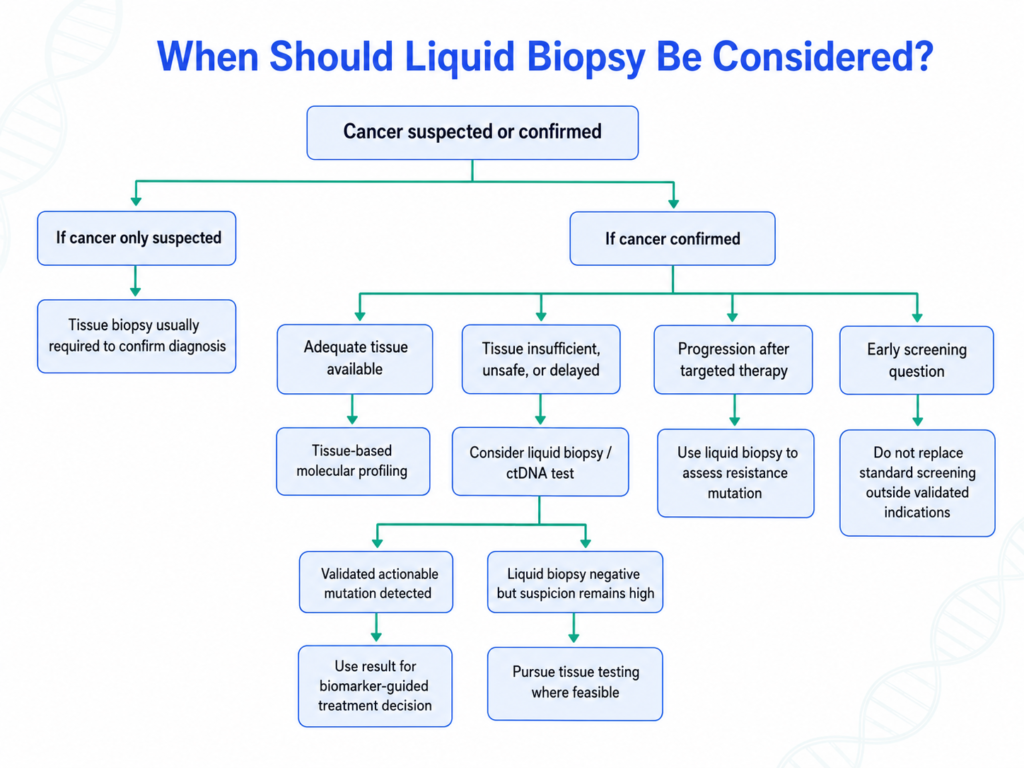
Decision Tree: When Should Liquid Biopsy Be Considered?
Liquid biopsy should be used when the result is likely to influence diagnosis, molecular classification, treatment selection, resistance evaluation, or follow-up strategy.
A practical clinical decision-tree may look like this:
- If cancer is only suspected → Then tissue diagnosis is usually required first to confirm cancer type.
- If cancer is confirmed and adequate tissue is available → Then tissue-based molecular profiling is usually preferred or performed first.
- If tissue is insufficient, unsafe to obtain, or delayed → Then liquid biopsy may help identify actionable mutations.
- If liquid biopsy finds a validated actionable mutation → Then the result may guide targeted therapy in the correct clinical setting.
- If liquid biopsy is negative but suspicion remains high → Then tissue testing should still be pursued where feasible.
- If disease progresses on targeted therapy → Then liquid biopsy may help identify resistance mechanisms.
- If early cancer screening is the question → Then liquid biopsy should not replace standard screening outside validated indications or trials.
This decision logic is especially important in precision oncology because the test itself is not the endpoint. The endpoint is whether the result leads to a better-informed treatment decision.
Why Liquid Biopsy Matters for Second Opinions
Liquid biopsy can be highly relevant during a structured cancer second opinion, especially when treatment has already started, tissue reports are incomplete, or the cancer has progressed after targeted therapy.
A second opinion should not simply repeat the diagnosis. It should review whether the right molecular questions have been asked.
Important second-opinion questions include:
- Was adequate molecular profiling done?
- Was the test tissue-based, blood-based, or both?
- Were all relevant biomarkers covered for this cancer type?
- Was the report interpreted in the context of stage, histology, and prior treatment?
- If liquid biopsy was negative, was tissue testing still considered?
- If a mutation was found, is it truly actionable or only biologically interesting?
This is where consultant-level interpretation becomes important. A liquid biopsy report can contain many genomic findings, but not every finding should change treatment.
FAQs About Liquid Biopsy
Is liquid biopsy the same as a cancer blood test?
Liquid biopsy is a type of cancer-related blood test, but it is not the same as routine blood tests such as CBC, liver function, or tumor markers. It looks for tumor-derived molecular material such as ctDNA and is used for specific clinical questions.
Can liquid biopsy replace tissue biopsy?
In most cases, no. Tissue biopsy is still needed to confirm diagnosis and define cancer type. Liquid biopsy can complement tissue testing, especially when tissue is inadequate, repeat biopsy is difficult, or resistance testing is needed.
How does liquid biopsy work for lung cancer?
In lung cancer, liquid biopsy can look for actionable driver mutations in blood. It is especially useful when tissue is limited or when the disease progresses after targeted therapy and resistance mutations need to be assessed.
What does a positive ctDNA test mean?
A positive ctDNA test means that tumor-derived DNA was detected in the blood. The clinical meaning depends on the cancer type, stage, mutation found, previous treatments, and whether that mutation has an approved or evidence-supported therapy.
Can liquid biopsy detect early stage cancer?
Liquid biopsy is being studied for early cancer detection, but it should not replace established screening tests in routine practice. Early-stage cancers may shed very little ctDNA, so false-negative results are possible.
What happens if liquid biopsy is negative?
A negative liquid biopsy does not always rule out a mutation or cancer activity. If the clinical need remains strong, tissue biopsy or tissue-based molecular profiling may still be required.
Related Articles
- Precision Oncology: How Biomarker-Driven Treatment Is Changing Cancer Care
- What Is Molecular Profiling in Cancer?
- Liquid Biopsy vs Tissue Biopsy: When Does Each Test Matter?
- How Targeted Therapy Works in Lung Cancer
Closing Perspective
Liquid biopsy represents a major shift in cancer care because it allows oncologists to study tumor biology through a blood sample. Its value lies in making cancer treatment more precise, more adaptable, and more responsive to molecular change.
At the same time, liquid biopsy should not be oversold as a universal cancer-detection shortcut. It is most useful when applied to the right patient, at the right time, for the right clinical question.
The future of oncology will likely combine tissue pathology, liquid biopsy, imaging, clinical judgment, and molecular tumor board interpretation. That combination, not any single test, is what defines responsible precision oncology.
Educational Disclaimer: This article is for educational purposes only and should not be used as a substitute for medical consultation. Liquid biopsy decisions should be individualized based on cancer type, stage, prior treatment, tissue availability, and treating oncologist assessment.